

Why Do Biorefineries Fail? Lessons from 20 Years of Industrial Experience
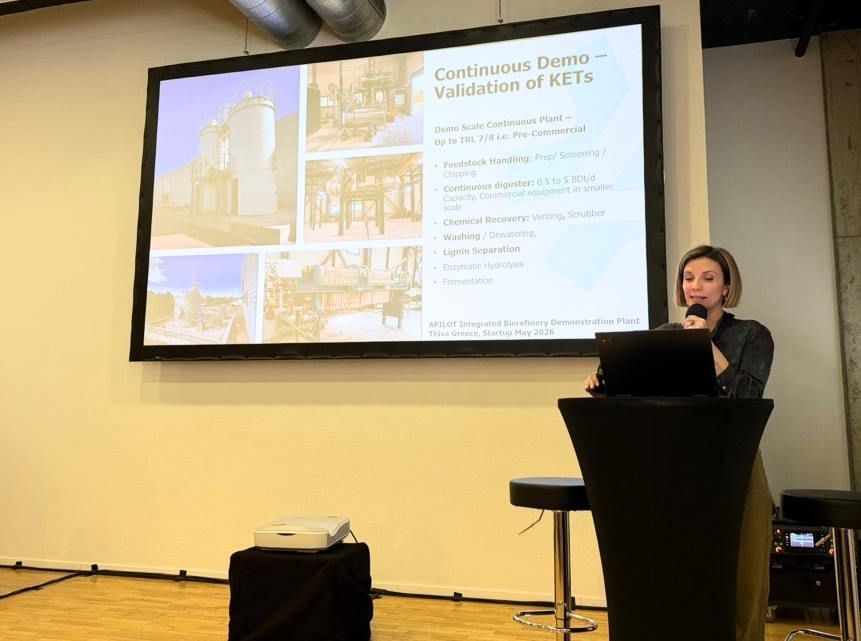
We are proud to share that Stamatina Sideri, our Business Development Manager, represented API Europe as a speaker at the BIOKET 2026 conference in Fribourg (March 17-19).
At BIOKET 2026, API Europe shared hard‑won insights from more than two decades of industrial biorefinery development, addressing a critical question for the bio‑based economy: why have so many first‑of‑a‑kind biorefineries underperformed or failed?
Despite strong market pull and policy support, deployment has proven far more challenging than expected. Experience shows that failure rarely stems from a lack of ambition or innovation, but rather from rushing to commercial scale without adequate derisking, weak scale‑up strategies, insecure biomass supply, and insufficient collaboration across the ecosystem.
A central message of the presentation was the importance of crossing the “Valley of Death” through continuous, integrated demonstration plants. Proper demo‑scale validation of Key Enabling Technologies (KETs)—up to TRL 7/8—is essential to de‑risk CAPEX, OPEX, product performance, and operational reliability before first commercial deployment. Skipping this step has repeatedly led to technical setbacks and financial underperformance.
Equally critical is the need for long‑term commitment. Successful biorefineries require 6–10 years of staying power, secured fiber supply with built‑in flexibility for feedstock variability, and long‑term offtake agreements to attract capital and stabilize operations.
The presentation also highlighted the paramount importance of open innovation. Defensive postures around IP, speed, and ownership often slow progress, whereas strong ecosystems—built on partnerships, shared learning, and collaboration—accelerate technology maturation and reduce risk.
These lessons are captured in the FIELDS™ framework, which defines the foundations of successful biorefineries:
- Fiber supply – Reliable, affordable biomass
- Investment – Deliberate, stepwise capital deployment
- Execution – Disciplined scale‑up
- Long‑term planning – Strategic vision and staying power
- Derisking – Stepwise validation of KETs
- Supportive markets and policies – Mandates and incentives
The conclusion is clear: biorefineries succeed in the field, not on paper. Long‑term thinking, disciplined execution, robust demonstration, and strong ecosystems—not speed alone—are what ultimately enable sustainable, circular bio‑based industries.